

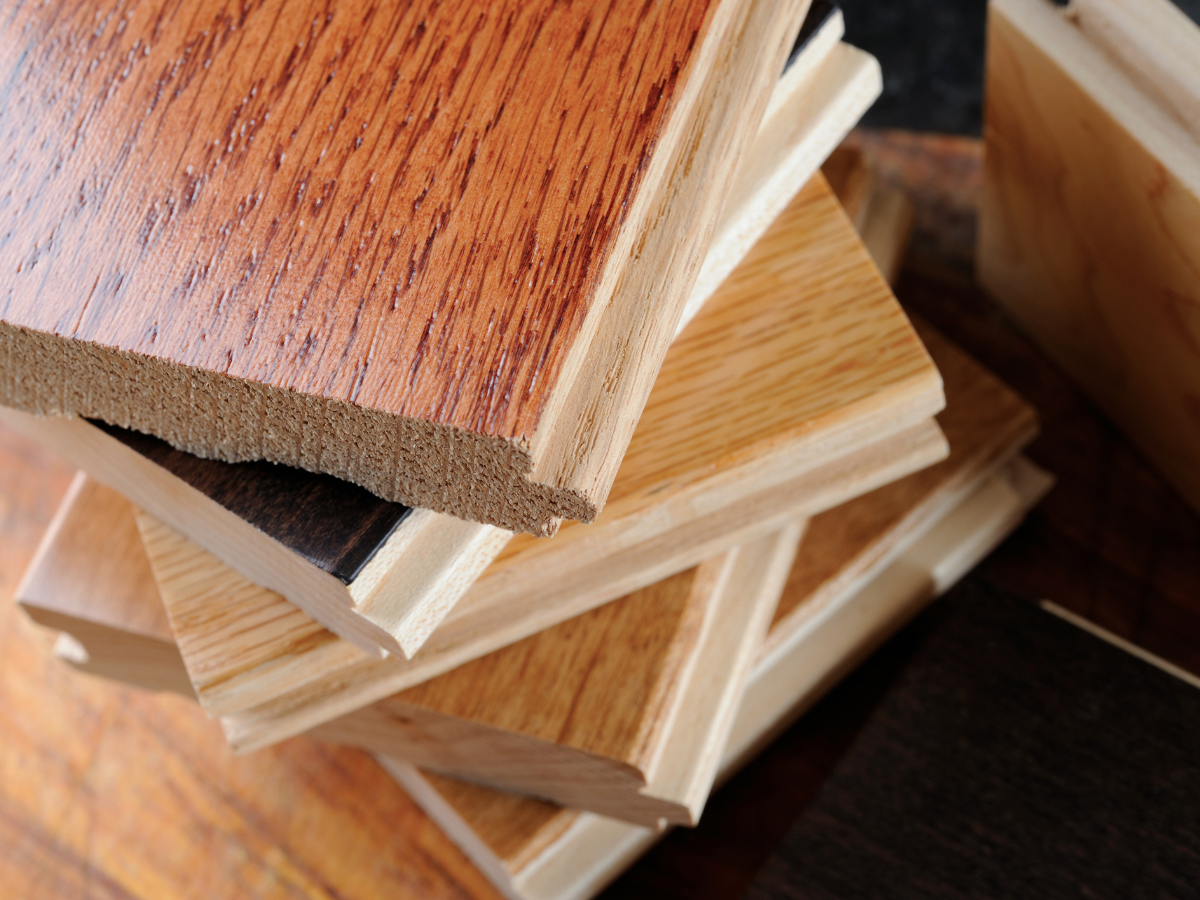
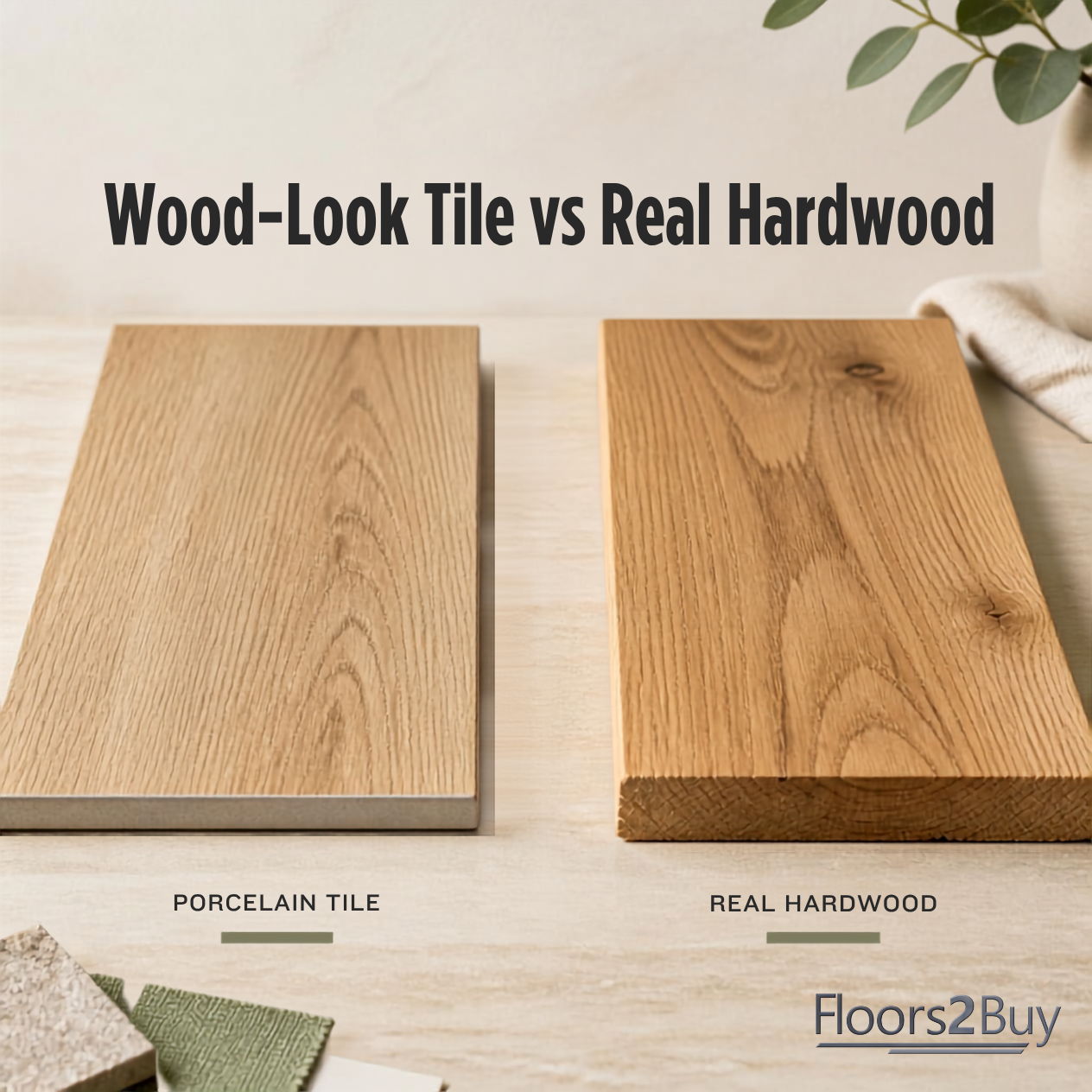
The argument happens at our counter at least once a week. Two samples side by side: a porcelain plank printed with oak grain so convincing you have to touch it to be sure, and a board of the real thing next to it. One half of the household wants the tile because it laughs at water. The other wants the hardwood because it is, well, wood. Both of them look at us like a referee.
Here is the ruling we actually give: this is not a contest with a winner. Wood-look tile and real hardwood are both excellent floors that happen to be excellent in different rooms, and the households that end up happiest almost always use both. The useful question is not which one is better — it is which room you are standing in when you ask. Room by room, the answers are surprisingly clear, and after 25 years of putting both materials into Pennsylvania homes, we can tell you where each one earns its keep.
How Wood-Look Tile Got Good Enough to Cause This Argument
A decade ago this comparison was easy to dismiss. Early wood-look tile repeated the same three printed planks across a whole floor, the fake grain lined up like wallpaper, and nobody was fooled from the doorway. That product is gone. Modern lines are made with high-definition printing that gives each plank its own grain, knots, and color variation, pressed textures that follow the printed pattern so your fingers feel what your eyes see, and long plank formats that lay out like a wood floor instead of a checkerboard.
You can judge the current state of the art in person: MSI’s Upscape wood-look porcelain and the Balboa wood-look planks both sit on our showroom floor at 245 Centerville Rd, a few steps from the genuine oak and hickory they imitate. Most visitors need the flip test — turning the sample over to find the clay body — before they trust their verdict. That is how far the category has come, and it is exactly why the room-by-room question now deserves a serious answer.
Underneath the convincing surface, though, the two products remain completely different animals. One is fired clay: waterproof through its body, indifferent to humidity, hard as the dishes it will someday break. The other is a living material: warm, quiet, repairable, and responsive to the seasons. Every verdict below flows from that difference.
The Differences You Feel After the Looks Stop Mattering
Since the visual gap has nearly closed, the decision comes down to everything a photo cannot show.
Underfoot, hardwood gives slightly with every step and holds room temperature; tile gives nothing and holds the temperature of whatever sits beneath it — which, in a Pennsylvania January, means cold. Anyone who has crossed a tile floor barefoot in February understands this difference at a level no spec sheet reaches. Radiant heating solves it beautifully where it exists, and tile conducts that warmth better than any wood can, but without it, tile is the floor that has you reaching for slippers.
Sound behaves differently too. Wood absorbs a little of everything — footsteps, voices, the dog’s toenails — while tile reflects it. A large open room floored entirely in tile has a faint echo that furniture and rugs must work to tame. Households with young kids, big dogs, or open floor plans notice this more than they expect to.
Breakability runs in both directions. Tile will never scratch the way wood does, but a cast-iron pan dropped on porcelain can chip it, and everything fragile that lands on tile dies on impact. Wood dents instead of chipping and gives dropped glassware a fighting chance.
Then there is the long game, where the two philosophies fully separate. Hardwood is the most repairable floor made: scratches buff out, boards swap in, and a sanding resets the entire surface — our professional floor repair team brings decades-old wood floors back to life across Lancaster County every month. Tile does not need that kind of rescue, because water and wear barely touch it; when damage does happen, the fix is replacing the cracked or chipped piece, which is why keeping spare tiles from the installation matters. Wood ages and renews. Tile simply endures.
Living With Each One, Week to Week
Daily care is where owners stop comparing spec sheets and start comparing lives, so here is the honest week-to-week picture.
Tile is the forgiving one. Sweep it, mop it with almost anything, steam it if you like - the surface does not care. Its one ongoing responsibility is grout: cementitious grout wants sealing on a schedule and a periodic scrub, because the grout lines, not the tile, are where a tile floor ages. Choosing a darker or urethane grout at purchase quietly removes most of that chore before it starts.
Hardwood asks for gentler treatment and better habits: dry sweeping or a barely damp mop with a wood-specific cleaner, mats at the doors to keep grit from sanding the finish, felt pads under the furniture, and a hard no on steam mops - the same tool that is harmless on tile voids warranties on wood. In exchange, wood offers what tile cannot: the ability to erase its own history. A tired hardwood surface can be renewed; tired grout can only be cleaned or replaced.
Neither routine is burdensome. They are simply different temperaments - tile forgives neglect but resists renewal; wood asks for care and repays it with renewal.
The Kitchen: Where the Argument Is Closest
Kitchens generate more of this debate than all the other rooms combined — fairly, because this is the one room where the two materials fight to a genuine draw.
The case for hardwood in the kitchen is comfort and continuity. You stand in a kitchen more than any room in the house, and wood’s slight give is measurably kinder to backs and knees across an hour of cooking. In the open layouts most newer Lancaster County homes use, hardwood also lets the kitchen flow into the living and dining space as one unbroken field — no transition strip, no visual seam, one material carrying the whole floor. Spills are a manageable risk, not a forbidden one: wiped promptly, they never register on a finished floor. We wrote up the pros and cons of hardwood floors in kitchens in full, and the short version is that tens of thousands of kitchens live happily on wood — with habits.
The case for wood-look tile is that it removes the word “habits” from the sentence. The dishwasher that fails during vacation, the refrigerator line that seeps for a month behind the cabinet, the dog bowl splash zone — tile does not care about any of it. For households that want the kitchen floor to be a solved problem rather than a maintained one, porcelain planks deliver the wood look with none of the wood worry.
Our honest tiebreaker, when a customer genuinely cannot choose: pick by how you cook and who cleans up. Daily cooks who stand for hours lean hardwood, with a cushioned mat at the sink. Households with a history of appliance drama, or where spills tend to be discovered rather than witnessed, lean tile. Neither choice is wrong in a kitchen; one of them is simply wrong for yours.
The Rest of the House: Faster Verdicts
Full bathrooms: tile, and it is not close. Daily steam, splash, and standing water are exactly what fired clay was born for and exactly what wood is not warranted to survive. Wood-look tile is a beautiful way to carry a wood aesthetic into the bath without asking wood to do the impossible — pick a matte or textured finish, because slip-resistant bathroom tile is a safety spec, not just a style choice. If you were hoping engineered hardwood could take this room, we understand the appeal, but a full bath exceeds what even water-resistant wood construction is built for.
Mudrooms and laundry rooms: tile again. Boot melt, salt, hose failures, and unattended water make these the hardest-working floors in a Pennsylvania house. This is the territory our guide to the best rooms in a home for tile flooring covers in depth — the rooms where tile’s indifference to abuse is the entire point.
Living rooms, dining rooms, and bedrooms: real hardwood, with confidence. These rooms carry no water risk worth planning around, which means tile’s one decisive advantage never comes into play — while every one of wood’s advantages does: warmth underfoot, softer acoustics, the way real grain ages into character instead of staying frozen in print. These are also the rooms buyers walk through when your house sells, and real wood still carries a cachet no imitation quite matches.
Basements: the room that flips the logic. Below grade, solid hardwood is off the table entirely — no manufacturer warrants it there. Your real choices are engineered hardwood, which handles the humidity swings of a Lancaster County basement gracefully as long as liquid water stays out, or tile over a properly prepared slab, which handles anything the basement attempts. Moisture history decides it: a dry, dehumidified basement can enjoy wood; a basement with a sump-pump history should choose tile and sleep well. Our comparison of solid vs. engineered hardwood in Pennsylvania’s climate walks through the moisture logic in detail.
Sunrooms and three-season spaces: tile, specifically porcelain. Rooms that ride our full temperature swing — the three-season sunrooms common on Lancaster and Chester County homes — freeze and thaw in ways wood flooring is never asked to tolerate. Porcelain’s near-zero water absorption is what makes it frost-rated, and a wood-look plank gives an unheated sunroom the warm appearance its climate would otherwise forbid.
Entryways and hallways: follow the neighbors. A front entry that opens into a tiled mudroom zone works beautifully in tile; a hallway feeding bedrooms belongs to the hardwood running through them. Halls and entries are connectors, and the floor reads best when it takes its identity from the rooms it serves rather than declaring its own.
Where Tile Meets Hardwood: Getting the Transition Right
Since most homes end up with both materials, the seam between them deserves more planning than it usually gets. Done casually, a tile-to-wood transition is a toe-stubbing height change with a clunky metal strip. Done well, it is nearly invisible — and the difference is decided before installation, not after.
Height is the technical half of the problem. A porcelain floor rides on backer board and thinset; a hardwood floor has its own stack-up. Depending on the products chosen, the two can land at different final heights, and the fix — a tapered transition, a flush threshold, or adjusting the underlayment — works far better when it is planned into the professional installation rather than improvised at the doorway on the last day.
Tone is the visual half. Kitchen flooring laid next to hardwood looks intentional when the two materials are clearly different or perfectly coordinated — and accidental when they are almost the same. A wood-look tile one shade off from the adjacent oak reads as a mistake from across the room. The reliable approaches: match closely using samples viewed side by side in your own light, or contrast deliberately, letting a stone-look or slate-look tile mark the working zones while wood carries the living space. We lay exactly these pairings out on the showroom floor, because this decision should never be made from two browser tabs.
What Pennsylvania Weather Does to Each
Our climate stresses these two materials in opposite ways, which is worth knowing before you assign them rooms.
Hardwood responds to the year. Muggy summers swell it, furnace-dry winters shrink it, and the difference shows up as seasonal gaps and movement unless indoor humidity stays managed — roughly 35 to 55 percent, which a humidifier and a dehumidifier maintain without drama. Engineered construction absorbs most of this cycle; solid wood demands more respect for it. None of this is a defect. It is the cost of a floor that is genuinely alive, paid in a little stewardship.
Tile ignores the year — the material neither swells in August nor shrinks in January — but it depends completely on what it sits on. A tile floor is only as good as the flatness and stability of its substrate, and Lancaster County’s housing stock keeps that requirement interesting: century farmhouses with springy old floor framing, city rowhomes with a hundred years of settling, new builds with slabs that need moisture testing before anything goes down. Tile over a subfloor that flexes will eventually crack along the movement, no matter how premium the plank. The preparation work you never see is most of what separates a twenty-year tile floor from a five-year one.
Read those two paragraphs together and the pattern is tidy: hardwood asks something of you every season, tile asks everything of installation day. Choose based on which kind of demand your household prefers to meet.
The Money Conversation, Without Fantasy Numbers
Prices move with product lines and market years, so any article quoting exact figures is already going stale — which is why this one won’t. The structural cost story, though, is stable and worth knowing.
Tile usually costs more to install and less to own. The labor is genuinely more involved — substrate preparation, backer board, thinset, grout, cure time — but the floor that results asks for almost nothing afterward beyond sealed grout and routine cleaning, and it does not keep a refinishing appointment in its future. Hardwood often runs the opposite ledger: the installation is faster and frequently costs less, while ownership includes eventual recoats and, someday, a sanding — expenses that are also the reason a wood floor can look new again at age thirty — a reset no other flooring type offers.
Stretched across the decades both floors are built to serve, the totals land closer together than the first quote suggests. Either way, the spend belongs in the rooms where the material wins outright — and flooring financing lets you do the whole plan at once instead of one room per year, which usually also earns better pricing on the combined job.
Wood-Look Tile vs. Hardwood: Quick Answers
Is wood-look tile better than real hardwood?
Neither is better outright. Tile wins wet and abusive rooms - bathrooms, mudrooms, laundry, sunrooms - because it is waterproof and frost-rated. Hardwood wins living spaces and bedrooms on warmth, acoustics, repairability, and resale appeal. Kitchens are a genuine toss-up decided by household habits.
Does wood-look tile actually look real?
Current lines are convincing enough that most shoppers need to touch the sample to be sure. High-definition printing varies the grain plank to plank, and pressed textures follow the printed pattern. The giveaways are underfoot: tile is harder, colder, and sounds different when walked on.
Is wood-look tile cheaper than hardwood?
Material prices overlap heavily; the real difference is in labor and ownership. Tile installation costs more because of substrate prep and grout work, but needs almost nothing afterward. Hardwood typically installs for less and carries future recoat and refinish costs - which are also what let it look new again decades in.
Which is better for resale value in Pennsylvania?
Real hardwood in the living areas remains the stronger buyer magnet, and listing descriptions treat it accordingly. Wood-look tile adds value in the rooms where buyers expect to see tile - baths, mudrooms - where it reads as an upgrade rather than a substitute.
Is tile too cold for a Pennsylvania home?
In winter, tile is noticeably cold underfoot without radiant heat beneath it. That is a reason to keep it out of bedrooms and living rooms, not out of the house - in kitchens, baths, and mudrooms, socks and bath mats have solved the problem for generations.
Can you put wood-look tile and hardwood next to each other?
Yes, and most homes that use both do. Plan the transition during installation: resolve the height difference with a flush threshold or tapered reducer, and choose tones that either match closely or contrast deliberately. Near-matches that miss by one shade are the combination to avoid.
Do the grout lines ruin the wood-look effect?
Less than they used to. Rectified wood-look planks take very thin joints, and grout color-matched to the tile makes the lines read as plank shadows rather than a grid. Ask to see a laid-out sample run, not a single tile - the illusion lives or dies in the layout.
Which is better for dogs: tile or hardwood?
Tile shrugs off nails, accidents, and water bowls completely, which makes it the low-worry pick. Hardwood coexists well with dogs when nails stay trimmed and harder species like hickory are chosen - and unlike tile, it can be refinished if years of traffic eventually show.
Two Materials, One House, Zero Regrets
Assign the rooms honestly and this stops being a dilemma. Tile takes the water and the weather: baths, mudrooms, laundry, sunrooms, and any basement with a damp history. Hardwood takes the living: bedrooms, family rooms, and the spaces where warmth, quiet, and real grain earn their keep daily. The kitchen goes to whichever demand — comfort or immunity — matters more in your household, and the seam between the two materials gets planned, not improvised.
The fastest way to settle your own room-by-room map is with both samples in hand. Browse the tile flooring in Lancaster and hardwood flooring in Lancaster collections online to build a shortlist — our tile flooring guide helps with formats and finishes — then come stand on the contenders at the showroom. When the map is drawn, request a free estimate: we’ll measure the rooms, check the subfloors and slabs each material would live on, and price the whole plan in writing, wood where wood belongs and tile where tile does. The households that get this right never think about their floors again. That is the entire goal.


